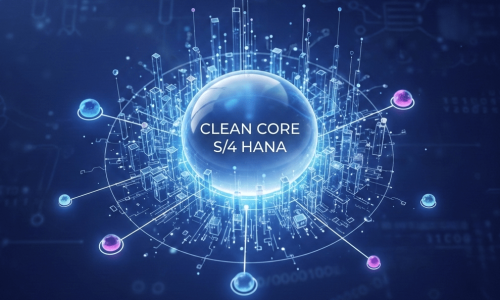
Clean Core is an ERP strategy focused on keeping the core system lean, standardized and upgrade-safe. In SAP S/4HANA, this means maintaining the system “as close as possible to its standard” and relocating custom logic to compliant extensions, typically built side-by-side on SAP Business Technology Platform.
The objective is simple: reduce technical debt, enable faster upgrades, and support continuous innovation without compromising system stability.
Clean Core combines:
- Core, the standard ERP system that must remain unmodified.
It spans these areas of SAP S/4HANA Cloud: Software Stack, Processes, Data, Integration, Operations and Extensibility.
- Clean, which means keeping each dimension up-to-date, cloud-compliant, optimized, and well-governed.
Together, Clean Core ensures SAP S/4HANA Cloud is maintainable, upgradeable, and ready for innovation, with high data quality, standardized processes, and lower total cost of ownership.

What is Clean Core in SAP?
A Clean Core strategy is how a company applies the Clean Core principles in its SAP projects. SAP describes an ERP Clean Core strategy as a framework to ensure that business-critical systems remain agile, cost-effective and ready for innovation. In practical terms, this means constantly using the latest SAP releases, minimizing or eliminating in-core customizations, and adopting cloud-compliant extensions and integrations.
By following this strategy, organizations can upgrade faster, reduce technical debt* and take advantage of new features (such as AI or analytics) without worrying that custom code will break on update.
*Technical debt refers to the implied cost of future rework and maintenance that results when organizations postpone modernization and rely on quick fixes instead of sustainable solutions.
Clean Core Principles (SAP Guiding Principles)
SAP defines four guiding principles: Avoid, Be Aware, Cloud Ready, and Decouple.
1. Avoid
“Avoid” refers to resisting unnecessary customizations. It’s a recommendation to, whenever possible, use SAP’s standard features and configuration instead of adding custom code. Too much custom code inside the core increases technical debt and makes upgrades harder – increasing costs in the long-term.
Why it’s important: Minimizing customizations makes the core more stable and safer to upgrade. Projects that follow a fit-to-standard approach (using SAP Best Practices and standard Fiori apps) usually have faster implementations, lower technical debt, and fewer upgrade issues. Less custom code also reduces maintenance effort and costs.
2. Be Aware
The “Be Aware” principle is about visibility and governance. It means knowing what’s in your system and managing it actively. This includes knowing your custom code and technical debt and reviewing them regularly. It also means having clear rules and processes for any changes.
Why it’s important: You can’t improve what you don’t understand. By staying aware of your custom code and technical debt, you can plan updates or improvements on time. Effective governance ensures that any new customization is justified, documented, and routed through the right channels. This prevents ad-hoc changes that later become hidden issues.
3. Cloud Ready
“Cloud Ready” means making sure your extensions and integrations can live in the cloud without friction. A key part of this is a zero-modification policy: do not change SAP’s core code. All customizations should use supported tools like standard APIs or events, so updates won’t break them.
Why it’s important: SAP cloud systems (public or private) deliver regular updates automatically. If your ERP core is modified, updates can fail or cause regressions. Staying Cloud Ready keeps the door open for hybrid or cloud deployments and faster innovation. By adopting SAP’s cloud innovations (AI tools, new modules, etc.), there are no nasty surprises.
4. Decouple
The “Decouple” principle means building new functionality outside of (or loosely coupled from) the core ERP. SAP’s guidance is to “leverage BTP (SAP Business Technology Platform) as a platform to innovate and automate with standard APIs and events”. In other words, any differentiating features or extra services should layer on top of the core, not live inside it.
Why it’s important: Separating custom logic from the core makes your ERP more modular. If a side-by-side app needs an update, you can do it without touching the ERP and cloud services can scale independently. Decoupling also allows using modern technologies without risking the ERP system.

Clean Core Dimensions
In SAP’s Clean Core strategy, the ERP core is not just a set of technical components, but it is defined by six fundamental dimensions. These dimensions represent the areas where complexity, technical debt, and risk often accumulate. A system is considered to have a Clean Core only when all dimensions are standardized, controlled, and safe to upgrade.
Software Stack
The software stack represents the standardized SAP ERP software with its core features, ready to run. From a Clean Core perspective, the objective is to keep it as close to standard as possible by avoiding changes to core SAP objects and minimizing custom code. Configuration should always be preferred over development, and custom code within the core should be minimized. A clean software stack ensures easier upgrades, system stability, and continuous alignment with SAP’s innovation roadmap.
Processes
Processes describe the complete business workflows that run in SAP S/4HANA and drive operational results. Clean Core promotes a fit-to-standard approach, where organizations adopt SAP standard processes instead of redesigning them through heavy customization. Reducing unnecessary process variants lowers complexity, simplifies maintenance, and enables faster adoption of new SAP innovations.
Data
The data dimension includes all configuration data, master data, and transactional data that support business processes. Clean Core requires strong data governance to ensure accuracy, consistency, and relevance across the system. Poor data quality, redundant records, or uncontrolled data growth directly increase system complexity and operational risk. High-quality data is essential not only for stable operations, but also for analytics, automation, and AI-driven capabilities.
Integration
Integration covers how SAP S/4HANA exchanges data with other SAP and non-SAP systems. In a Clean Core strategy, integrations should be loosely coupled, transparent, and safe for upgrades. Custom integration is replaced by API-first connectivity and SAP integration services. Modern integrations can use SAP Event Mesh for asynchronous communication, ensuring the core doesn’t “wait” on external systems.
For Code10, SAP BTP is the recommended platform for building extensions outside the core. Whenever it is possible, all integrations should follow Clean Code levels: APIs first, then IDocs (standard SAP format to exchange data between system) where applicable, and preferably ABAP Cloud or released objects.
The rule is clear: always check whether a standard API or integration mechanism exists before building anything custom. Only build side-by-side extensions if no supported interface exists.
Operations
Operations include the ongoing governance and maintenance activities required to keep the system running reliably, such as release management, monitoring, background job control, authorizations, and system health checks. Clean Core demands disciplined operational practices to ensure that upgrades, patches, and innovations can be applied smoothly. One of the most common Clean Core failures Code10 experts observe is relaxation after go-live. Maintaining Clean Core requires strong governance, well-definined development processes, and continuous oversight. Without this, the system can quickly accumulate technical debt again, increasing operating costs and delaying innovation.
Extensibility
Extensibility refers to any functionality added beyond SAP standard capabilities. Clean Core does not prohibit customization, but it enforces where and how extensions are built. Clean Core separates extensions into two categories:
- In-App Extensibility (using no-code/low-code tools like Key User Extensibility inside S/4HANA).
- Side-by-Side Extensibility (using SAP BTP with released APIs and events). Both are safe for upgrades because they use ABAP Cloud and released APIs.
The preferred approach is Side-by-Side extensibility, because building extensions outside the core keeps the system stable while still allowing the business to innovate and create solutions that set it apart from competitors.
How to Get to a Clean Core
As a certified SAP partner specialized in integration and cloud technologies, Code10’s general recommendation is aligned with SAP’s Clean Core strategy. Whenever it is possible, we advise keeping the core standard, extending at the edges, and ensuring long-term upgrade safety.
Naturally, from the early phases of each S/4HANA project, our consultants evaluate business requirements case-by-case. For every customization request, we first assess whether standard capabilities can meet the need. When a standard alternative exists, we recommend process optimization instead of custom development.
When a Clean Core approach is possible, we turn it into a continuous exercise. Code10 emphasizes strict development standards and post-go-live discipline to prevent the core from degrading over time.
In general, it is possible to start a Clean Core project in two typical scenarios:
New Implementations (Greenfield):
When implementing a new SAP S/4HANA environment, design it with a Clean Core from the start. Adopt SAP Best Practices and a “Fit-to-Standard” approach to design processes. This approach:- Reduces custom code and complexity.
- Makes future updates, innovations, and new features (like AI or analytics) easier and faster to adopt.
- Keeps the ERP core standard and compatible with upgrades.
Example: Instead of creating custom workflows in the core, build extensions using side-by-side apps on SAP BTP or in-app tools, keeping the ERP foundation untouched.
Migrations (Brownfield):
When migrating an existing SAP ECC or older S/4 system often brings inherited Z-code customizations and process variations. Migration is a good chance to clean the core by:- Reviewing and retiring outdated or unused Z-code and custom objects.
- Moving essential custom logic to side-by-side extensions on SAP BTP.
- Evaluating processes to remove unnecessary variants and align with SAP best practices.
Based on Code10’s experience, the biggest risk in S/4HANA migrations is simply carrying over legacy problems. When companies migrate without re-evaluating their processes, they inherit outdated workflows, excessive custom code, and technical debt that slows down upgrades and innovation.
In summary, Clean Core is the recommended best practice approach for any SAP S/4HANA project: it ensures an efficient, maintainable ERP foundation that can adapt to future business needs.
Comparative Greenfield vs. Brownfield
 |  | |
| Greenfield Implementation | Brownfield Implementation | |
| Starting Point | New SAP S/4HANA Cloud system, no legacy configuration or custom code. | Existing SAP ERP system converted to SAP S/4HANA, including custom code and configuration. |
| Clean Core Baseline | Clean by design, aligned with SAP standard best practices. | Not clean initially, legacy custom code and modifications must be reviewed. |
| Handling Custom Code | Only approved extensibility models used, no inherited code. | Inherited custom code may need adaptation or replacement. |
| Data Migration Scope | Master data and open transactions; history archived | All historical and transactional data retained |
| Technical Debt Risk | Very low: no inherited complexity. | Medium: the core must be cleaned first |
| Innovation Readiness | High: updates can be quickly implemented. | Slower initially: system must first reach Clean Core compliance to take the most out of innovations. |
| Implementation Complexity | More business transformation work, less technical cleanup. | Less organizational change initially, more technical remediation. |
| Recommendation for use | When seeking a complete transformation, total standardisation and simplification. | When you want to preserve existing processes and historical data and reduce disruption to your business. |
Benefits of a Clean Core Strategy for your Business
A well-executed Clean Core delivers many concrete benefits:
- Faster upgrades and innovation: With fewer in-core customizations, SAP upgrades become simpler and lower risk. Organizations can adopt new releases, features, and security patches faster.
- Lower Total Cost of Ownership (TCO): Less custom code reduces maintenance, defect resolution, and testing effort. Over time, companies cut support costs and free up resources for innovation instead of maintaining legacy developments.
- Improved stability and performance: A standardized core minimizes errors and avoids complex custom ABAP, resulting in smoother operations and better user experience.
- Greater agility and flexibility: By enabling side-by-side extensibility on SAP Business Technology Platform (BTP), businesses can develop new capabilities without disrupting SAP S/4HANA, preserving system integrity while adapting quickly to change.
- Stronger integration, data, and security: API-driven integrations, consistent data structures, and reduced custom modifications improve scalability, governance, and compliance while lowering the overall risk profile of the ERP landscape.
Clean Core is the foundation of agile ERP and business transformation. It unlocks faster innovation, cuts long-term costs, and provides a future-ready ERP platform aligned with cloud strategy.
How Code10 applies the Clean Core Strategy
The success of a Clean Core implementation depends not only on architecture, but on expertise. Code10’s SAP specialists combine deep technical knowledge of SAP S/4HANA, integration architecture, and extensibility models with real-world transformation experience. Our consultants understand both the functional implications of process standardization and the technical impact of in-core modifications, ensuring that every decision balances business value with architectural integrity.
Adopting a Clean Core strategy is the difference between an ERP that limits your potential and one that unlocks your future growth. We are your SAP partner to help you navigate the complexities of S/4HANA with a clear roadmap and the right tools to keep your core standard and your modernisation limitless.
Contact us and let’s discuss your project needs: info@code10it.com