
For many companies, growth today depends on one key factor: how well they manage and use their data. Every click on a website, every purchase, every message, every search and every interaction leaves a digital footprint. The real challenge is not collecting this information – most organisations already do that – but implementing a Data Modernization Strategy to manage it in a way that makes it accessible, reliable and useful.
For businesses, data is no longer just a technical resource managed by IT teams. It has become one of the most important strategic assets a company can have. When data is properly structured and connected across the organisation, it enables companies to understand customers more clearly, improve products more efficiently, optimise operations and make smarter decisions with confidence.
Years ago, decisions were mainly based on intuition and experience. Today, they are supported by evidence. No more guessing what customers might want: patterns can be identified in the data. Instead of reacting when it is too late, companies can anticipate trends and prepare for what comes next. But this shift requires more than just having data; It requires the right foundations to ensure that information can scale, integrate and adapt to new business demands. Data is the compass. It does not replace leadership or creativity, but it provides direction. And in a competitive world, direction makes all the difference.
The Evolution of Data Modernization
We are going through a period of technological evolution in how businesses use data.
In current and old systems – take SAP Business Warehouse 7.5, for example – data from different parts of the company is stored in a single place, a large ‘silo’ where all data is consolidated so it can be analysed.
So, what is the issue? When everything sits in one place, changes or operation made the data can affect areas of the business that should remain unaffected. The problem is not the databases used, but rather that all processing happens within the same environment.
Another problem with the older approach is scalability. As these systems, like the example of SAP BW 7.5, are mainly on-premise, they suffer from both horizontal (more machines running) and vertical (machine power) scalability issues.
In addition, many customers look for modular solutions to tackle problems in specific parts of the business without having to invest in other areas of the system. However, with all data centralised, that flexibility was not possible. For this reason, and due to other technical limitations, data architectures have over the years. At the same time, software providers are preparing for the end of maintenance for these systems, pushing the entire industry to continue improving and modernising. In the example of SAP BW 7.5, standard support is planned until the end of 2027, with optional extended support until the end of 2030.
How Data Modernization Looks Today
The traditional, centralised data model has evolved in recent years into a microservices-based architecture, driven by the adoption of the cloud. In this case, each microservices works as a ‘silo’ for every area of the business, shifting from the classic model.
This partly solves the problem of modular sales, allowing companies to expand services in the specific areas of their business that needed it. In addition, it has facilitated maintenance and updates by allowing them to be undertaken separately, without affecting other areas.
Another major benefit is the ability to easily scale horizontally and vertically at the convenience of the business.
However, this system still faces one problem: the communication between the different ‘silos’ or areas of the business. In this architecture, Application Programming Interfaces (APIs) facilitate the data exchange between two systems. However, each API is built for its system, in operate within their own environment. As a result, the integration across these areas depends on having specialists who understand each technology and can connect them effectively.
OData: Powering the Next Phase of Data Modernization
As data modernization advances, one of the key developments supporting its transformation is the OData protocol.
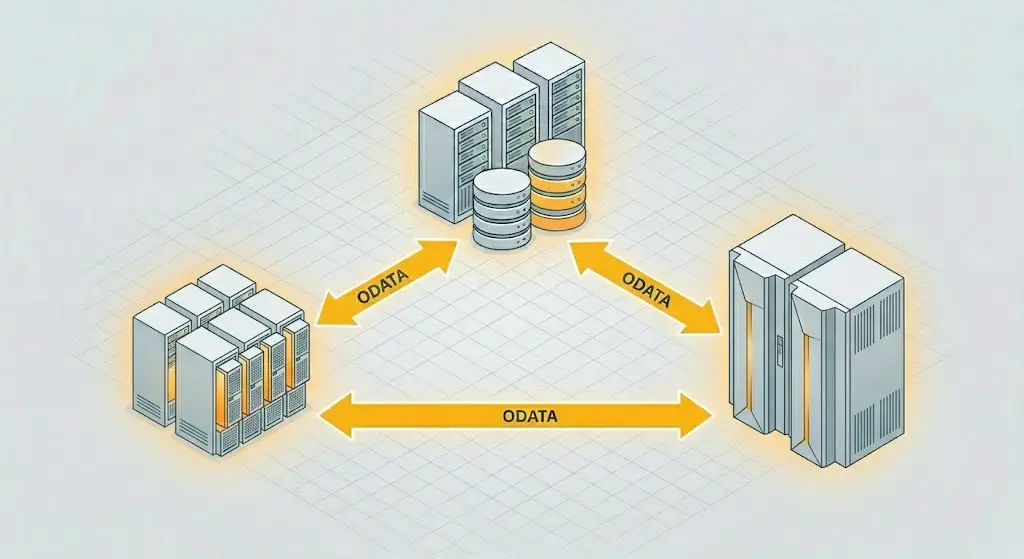
OData stands for Open Data Protocol, and it was created by Microsoft and currently managed by the OASIS organization. It defines the standards for building and consuming RESTful APIs (APIs that connect two systems and allow them to exchange data in a safe way), allowing real-time connectivity in a simpler way.
Remember when Apple changed the charger for its devices to the USB-C charging port standard? That is what OData does: it ensures universal compatibility and benefits the entire ecosystem, which no longer needs to speak the different and specific languages of systems such as Salesforce, Microsoft Azure, and other modern web services.
In the example of SAP BW 7.5, using OData would enable the automatic, real-time communication with external platforms such as Azure and Amazon Web Services (AWS), allowing data to be exchanged seamlessly.
From Data to Decisions: The AI Revolution
Companies that want to effectively implement Artificial Intelligence (AI) but fail to do so often have data foundations, not compatible with this type of innovation. Systems such as SAP BW 7.5, have not been designed to handle the massive and elastic demand for resources from Machine Learning.
The transition to cloud infrastructures has enabled horizontal and vertical scalability to handle AI’s workload peaks. Elasticity is crucial because the need for increased AI processing capacity is not usually constant; rather, it tends to spike during model training or complex reasoning. In addition, AI models need standardised, high-quality data to learn effectively. Starting the modernisation of your data or moving to the cloud ensures that all data “speaks the same language”. It therefore makes it much easier to use it as a leverage in a world of data-driven decisions, where you no longer react to changes, but anticipate your company to them.
How Code10 helps businesses modernise their data
At Code10, we have a team with extensive project experience, ensuring best practices when modernising data and maximising its benefits, leading cost savings and a future-proof infrastructure.
The transition to the cloud and the availability of high-quality cloud architecture make it possible to anticipate peaks in data demand, which we can cover thanks to flexible scalability in different areas. Similarly, we also reduce cloud capacity once the peak has passed, providing a balance that optimises stability without unnecessary infrastructure costs.
Our consultants also have experience in guaranteeing zero downtime for our clients’ projects, maintaining operations throughout the duration of the project.
Contact us to learn more about how Code10 can help you modernise your data and make better decisions, future-proofing your IT infrastructure: tell us about your needs in the form below of by emailing info@code10it.com.