Modern companies no longer work with a single central system. They operate complex digital landscapes where SAP, cloud applications, legacy systems, third-party platforms, analytics tools and customer-facing applications need to communicate with each other constantly.
This creates a challenge for IT teams and business leaders: how can all these systems stay connected without creating a rigid and difficult-to-maintain architecture?
For many years, integration has mainly relied on direct communication between systems. One application asks another for information, receives a response and continues the process. This approach is still important and will continue to be part of SAP integration.
However, not every business process should depend on systems constantly asking each other whether something has changed.
Sometimes, the smarter approach is different: when something happens, the system should simply notify the rest of the landscape.
This is where SAP Event Mesh becomes relevant.
Why SAP integration needs more flexibility
Today’s IT landscapes are increasingly distributed. A company may have SAP S/4HANA as its digital core, but also Salesforce, an e-commerce platform, warehouse systems, mobile apps, reporting tools and many other applications.
Each system may use different technologies, security models, authentication methods and integration requirements. As the number of systems grows, point-to-point integrations can become harder to govern.
The problem is not only technical. It directly affects the business.
If systems are too tightly connected, every change becomes more difficult. Adding a new application, changing a process or scaling an existing integration can require significant effort. Over time, the architecture becomes less flexible and more expensive to maintain.
SAP Event Mesh helps address this challenge by supporting a more event-driven way of connecting systems.
What is SAP Event Mesh?
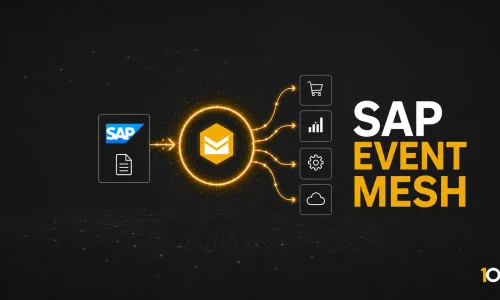
SAP Event Mesh is a service that allows applications and systems to communicate through business events.
In simple terms, it acts as an intermediary between the system where something happens and the systems that need to react to it.
For example, if a sales order changes in SAP S/4HANA, SAP Event Mesh can help communicate that change to other systems. Those systems can then decide what to do: update a customer portal, trigger a logistics process, notify a sales team or refresh a reporting dashboard.
The important point is that SAP S/4HANA does not need to call every system directly. It publishes the event once, and the interested systems consume it whenever they want.
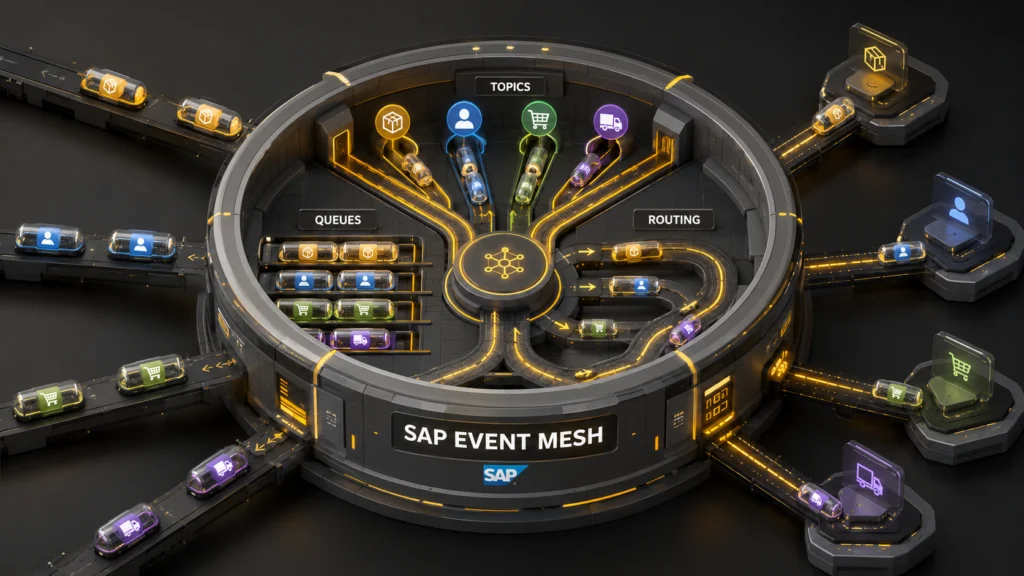
The most important principle is decoupling the producer from the consumer, so the Event Driven architecture can be explained by “The producer generate an event (message) to the Event Broker (in the case of SAP Event Mesh) and the different consumers that are subscribed to the topic can consume it whenever they want.”
This makes the architecture more flexible, because systems are no longer so dependent on direct connections with each other.
A simple way to understand events
An event is simply a message that says: “something has happened”.
That “something” could be:
- A customer has been updated.
- A product price has changed.
- A sales order has been created.
- A delivery status has changed.
- A stock level has been updated.
The event does not always need to include all the business information. In many cases, it only needs to notify that the change happened. Then, if another system needs more details, it can request them through an API.
This is one of the key ideas behind event-driven integration: events notify, APIs complete the information when needed.
From direct connections to business events
In a traditional integration model, systems usually communicate through direct requests.
For example, an external application may ask SAP every few minutes whether a specific order has changed. This can work, but it can also create unnecessary traffic and dependency between systems.
With an event-driven approach, the logic changes.
Instead of asking repeatedly, the external application waits for an event. When the order changes, SAP publishes the event. The application receives it and reacts.
This model is especially useful when several systems need to react to the same business change. Instead of creating multiple direct connections from the source system, each consumer can subscribe to the event and act independently.
The result is a more decoupled architecture.
A simple SAP Event Mesh example
Imagine a company with SAP S/4HANA, an online shop, Salesforce and a logistics application.
Several things can happen during a normal business process:
A customer updates their account in the online shop.
A product price changes in SAP S/4HANA.
A new order is created.
An existing order changes status.
All these changes may be relevant for other systems.
The customer update may need to be replicated to Salesforce.
The product change may need to be reflected in the online shop.
The order update may need to trigger a logistics process.
Without an event-driven approach, the company may end up building several direct integrations between systems. Over time, this can become difficult to maintain.
With SAP Event Mesh, the process becomes simpler from an architectural point of view.
When a relevant change happens, an event is published. SAP Event Mesh receives it and makes it available to the systems that are interested. Each system can then react according to its role in the process.
This does not mean that all integrations become automatic or that APIs disappear. It means that events become the trigger that helps systems react faster and with less dependency.
Why it matters for business
The value of SAP Event Mesh is not only technical. It supports a more agile way of running and evolving business processes.
Less dependency, more agility
When systems are directly connected to each other, every change can have an impact on several applications. This makes transformation slower and more complex.
SAP Event Mesh helps reduce this dependency. The system that creates the event does not need to know exactly who will consume it. It only communicates that something happened.
This makes it easier to add new consumers, extend processes or connect new applications without redesigning the whole integration landscape.
A landscape ready to evolve
Business requirements change constantly. Companies launch new channels, adopt new platforms, automate processes and connect new partners.
A rigid integration model can slow this evolution down.
An event-driven approach gives companies more room to grow. New systems can react to existing events, and business processes can become more responsive without overloading the core system with unnecessary direct connections.
For SAP customers, this is especially relevant when modernizing their landscape around SAP BTP, cloud applications and side-by-side extensions.
Code10 view
At Code10, we see event-driven architecture as an important part of the future of SAP integration.
It is not about replacing every existing integration pattern. APIs, integration flows, batch processes and traditional mechanisms will continue to have their place.
The real value is knowing when events make sense.
SAP Event Mesh is especially useful when a business process needs to react to changes: a customer update, an order creation, a product change or a status update. In these cases, event-driven integration can reduce complexity and help systems communicate in a more natural way.
For companies working with SAP landscapes, this means more flexibility, better scalability and a stronger foundation for future innovation.
Conclusion
SAP Event Mesh helps companies move from rigid system-to-system connections to a more flexible, event-driven integration model.
Instead of making systems constantly ask whether something has changed, SAP Event Mesh allows them to react when business events happen.
For business leaders, this means a more agile and scalable architecture. For IT teams, it means less coupling, better extensibility and a cleaner way to connect SAP and non-SAP systems.
In a world where companies need to adapt quickly, integration should not become a barrier to change.
SAP Event Mesh helps make sure it does not.